Friday, September 25, 2020

burning Nationalism

 or Undetected echo-chambers! 

Since the latest media revolution, especially since it social media part, with the take off of Facebook, Twitter et al the echo chambers (Wp with backgrounds) is a topic, which is burning like the planet. Especially since the Trump Presidency this topic gained more attention, see as an e.g. this article in "The Conversation", which is also refering to Trump. But the topic has a longer history, even when referrerd to other key-words, like "Denialists", which is used by Naomi Klein (2014). The concept of "Denialism" (WpE) looks as it might psychological misconception of (some) individuals to face the truth:    "The facts are not getting through as Anne Applebaum is expressing this so eloquently in the "Atlantic". While I don't doubt that there a psycholigical factors contributing to this, I doubt that it should be reduced to psychological reasons alone. 

The thesis of the post (and the background research) is: These echo chambers have been there since the establishment of the public sphere (WpE, has also the link to the important book form Habermas (1962/1989). Habermas is making clear that the public sphere is an ideological construct, which is always giving a certain groups of members access to it. Whealthy white man had access to since the creation of this publich sphere, in the (respective) national-states. While the access has broadend since the 20 century, one essential restriction of access has not been eliminated and is contributing to existence of "burning nationalism", which is language. Without the sufficient knowledge of the national language a contribution to the publis sphere was not possible. One might argue, that it is the fact, that a member of the public sphere is born into the language. However, the relation is more complex, somewhat comparable to "gender" (WpE has some fact about the background of the concept)  as a social category, compared to the biological sex (McEhlinny 2012 gives backgounds to th comparision of gender and language): Language is a made a category made by certain types of societies, which are called national states. While "gender" and "race" (Kendi 2017 for more) has been researched lately, the research of  "language" a social construct is still in the initial stage. There are several reasons for the problems with this research, but they have to be adressed, because if they stay hidden, one of the most important hidden backgrounds of the dangerous "buring nationalism" keeps on smoldering.     

References:

  • Kendi, Ibram X (2017), Stamped from the Beginning: The Definitive History of Racist Ideas in America, Nation books     
  • Klein, Naomi (2014), This changes everything: Capitalism vs. the climate, Schuster & Schuster 
  • McElhinny, Bonnie (2012), Silicon Valley Sociolinguistics? Analyzing Language, Gender and Communities of Practice in the New Knowledge Economy, in: Language in Late Capitalism: Pride and Profit (Routledge Critical Studies in Multilingualism) ed by Duchêne, Alexandre    

Monday, July 27, 2020

After the Corona-Crisis: A New & Green Deal for the World?

Foto: Nuon/Jorrit Lousberg

While the Corona-Pandamic is indeed far from over, speculations about the future giving hope in these dark times. Even the large EU rescue plan, which also includes a strong green component seems to be not enough as Greta Thumberg point out (in the Guardian). Joe Biden announced a plan for Green Energy, which will nevertheless will be diffucult to implement. (both links Guardian) Are Greta Thumberg or Oliver Milman too strict or too pessimitic? No, that is not the problem, but hope alone is not enough for creating a change in the problem of climate change. There are real complexities involved. Recently Jeff Gibbs and Roger Moore tried to show some of the problems "Green Energy" is going to face (youtube-link to the film), but they really showed is that it is not easy to make a film about such a complex matter (as the critics of "debunked" showed, see also the Wikepedia-page for more backgronds). While there are films about climate change and environmental problems, e.g. "A Fierce Green Fire" or the "4.Revolution", about a shift in the energy production (in German), these matters are not easy to explain in a film. Wikipedia-pages (not one page alone) can convey a better picture, but for this several pages has to be combined. At first there is no page called "climate change", there is the page "climate variablity and change", if one searches for "climate change", there is a direction to "Global warming" (see the link), which is the effect of climate change globally, not locally. There might be place, which acutally get colder, an example could be Europe, if the North Atlantic Current would get weaker, not only because of Global warming, but also changes in ocean. In short: "Global warming" is only a headline of a much more complex process. The complexity is also affecting the discussion about climate change, which is indeed a very complex change, a much better conceptual tool is the Anthropocene debate. But how should the New & Green deal? For the reduction of complexity I have to concentrate one factor, which seems to of central importance: energy denisity (Wp). Solar power has, compared to coal or Gasoline, a low energy density. The means you need to create very big solar panels to create the energy, that is saved in a liter of fuel (Homer-Dixon 2006). And more problems:  1. solar power is difficult to save. Batteries are still expensive and their lifespan is not so long. 2. Intermittency: If it is cloudy the sun is weaker and there is not so much energy. 3. EROI (=Energy return on investment, Wp). Solar energy needs large investments and there is less money coming back, compared to fossil energy. Fossil energy is developed since over 150 years and EROI is still large. All these four reason are not strong enough to impede thenecessary transition from fossil energy to renewable energy, but they show the complexity of this transition. It can be seen in Germany, which was one of the first countries to start an Energy transition (an URL about some of the problems), but still a lot of problems are unsolved. But these arguments are largely not heard in public, specialists of course know some of the problems, but maybe it is difficult to find ONE specialist, who has the solution for all the problems, because there are not only technical, but also social (see social engineering) or political. It seems to be, that a more decentral energy supply would be helpful, for a transition to renewable energy, but here are massive economic interests involved, which make such transitions difficult (even in Sweden, see the case of the rafinery Lysekil). And an international deliberation is more needed than ever. Not only for specialists, but for the international public as well.                                               
Reference
Homer-Dixon, Thomas (2006), The upside of down, Resource and Conflict Analysis, (Souvenir press), London  

Saturday, July 11, 2020

patterns of social engineering (not only masks...)

Social engineering (WpE), in "Applied"Social Sciences, is multidmensional concept see Disambiguation pages in Wikipedia. Here used as an attempt of institutions to change the culture, in the sense of the social behaviour of the cultural agents. This article will demonstrate dimensions of social engineering related to three aspects:
  1. individual behavior, especially wearing masks
  2. the new corona warn app
  3. some findings on testing and vaccination    
1.Although the Covid-19 pandemic is far from over, the numbers are showing clearly distinct cultural patterns: this was discussed briefly in a post before and more in depth analysis about France, Germany and Japan can be seen here (showing presentations from June 18., organized by the Maison Franco-Japanese and Deutsches Institut fuer Japanstudien, both in Tokyo). Discussing the previous post in my seminar, I learned that the wearing of face masks is in Japan introduced in school during the delivery of the school lunch meals, by the students. To prevent the spread of influenza germs the elementary school students are trained to wash their hand thoroughly and wear masks. This influenza protection hygiene in Japan seems to be one (cultural) factor very important for the relatively low death rate of Covid-19 in Japan.   
2.Corona Tracing Apps are one another important aspect, closely related to social engineering in the 21st century. But in this context an explicit definition of "social engineering" is needed, because searching (on Google) the terms "social engineering corona apps" is showing some interesting results: "What COVID-19 teaches us about social engineering?" (Blog "Dark reading"), but here "social engineering" is meant in the sense of information security, while this post is covering "social engineering" as a concept in the social sciences, which talks about possibility to change the social behaviours of people (= the culture) through technical measures. But is the Coronoa tracing app really social engineering? i.e. Is the Corona tracing app designed to change the behaviour of persons? The answer can only be: It depends on the app! There are various Covid-19 apps (Wp) around. Some countries are using the Covid-19 pandemic to expand mass surveillance (Guardian) on their own population. The Norway example (tech-crunch) shows that in this country the warnings of Data protection Agency is this country is taken seriously. And other Apps are specially designed not to be violate the privacy of its users. The swiss developted app (BBC, see also, in German, Spiegel online and the NZZ about the app-development) designed in cooperation with Apple and Google is built to avoid data-storage at a central place. The App can therefore only used to inform about the possibility of a Covid-19 infection. In the case of this app, the level of social engineering is deliberately low. The app called COCOA (see Mainichi-article 28/6/2020) in Japan (The Verge, 19/6/2020) developed in cooperation with Microsoft follows the same principles. Not all countries developed an own app in the UK (Guardian) the Google and Apple will be used directly. But in countries, where the decentral Bluetooth-approach is applied the social engineering aspect of the apps is (in the moment) very small, the users only have to install the new app, but they do not have to change their behaviour in other ways.
3. Testing and vaccination is not all aspects linked to individual behaviour. Only when a person decides to go to doctor and get a vaccination (e.g. against Influenza), this would be a relation to individual behaviour. But epidemic outbreaks shape social behaviour, as one can see in Covid-19 pandemic, therefore the prevention of pandemics also has great influences. And the prevention of pandemics was after the 19 century: vaccination. Vaccination policies (Wp) were rolled out to prevent epidemics and create immunity in the population ("herd immunity"). But mandatory vaccination has also be a controversial issue, as the history of anti-vaccination shows. (History of vaccines, Blog). In a lot of countries the population does not trust their governments, because of the history of oppression and it not surprising that the trust of population to their governments is in some african countries very low.  (Médecins Sans Frontières = MSF, see also the Interview of Karline Kleijer of MSF in Spiegel online, in German).       


Tuesday, June 16, 2020

The masks of culture (in the Corona-world = Introduction)

Corona (Covid-19) has been a topic of this blog since March 19. with subsequent posts. This crisis exposes important facts, that are normally not covered in the pictures of a normal life. Climate Change is very abstract, this is also the fact for other changes since the late 20th century, like the ongoing loss of biodiversity. The Covid-19 crisis, however, is affecting the daily outcome of most of the people of this planet directly or indirectly.  

This graph from the John Hopkins University illustrates the global situation, especially, when compared to the graph at the post from the situation of 20/3/2020. However, the data also point to a problem: Why are the number of the cases develop so differently between different countries?  Of course the most obvious short answer, refers to the actions (or not actions) taken by the national governments. But the interesting background of an pandemic is that the number of cases really reflect the situation on the ground. If the government is advising the people to stay at home, but they are not following this request or order the number of cases is going up. And in this respect the situation in Japan is interesting, because if you look at the government`s actions, especially testing (the Guardian article from 2.April 2020). The data is a bit old, but it shows clearly the tendency: Japan was not very strict, in the beginning, later the country also moved into a lock down and testing regime got more strict. But compared to Germany, where the testing was quite strict from the beginning, test number of cases are considerably lower in Japan. And here come one factor, which can be named the factor "culture", which sounds of course in the beginning quite abstract and complex. In this very case "culture" is showing through the use of masks. The difference between high context and low context cultures (Wp) is still quite abstract. But a look at the history provided by the book (Horii 2012) shows that the Japanese custom of using masks can be traced back to Influenza pandemic 1918 (Wp gives an overview). The historical background provided shows one aspect of the "culture", the willingness to wear masks. 

Reference:
Horii, Mitsutoshi (堀井光俊, 2012), masks and Japanese,マスクと日本人、出版社shi


Monday, May 11, 2020

what can we do?

Some Reflections in times of the Corona-Pandemic (updated version)
In these times it difficult not feel helpless and vulnerable. But what could one possibly do about this? Of course the situation is the same everywhere, so these reflections should be seen as optional, more about this later. Because of Social Distancing (Wp), which means in most of the cases means staying home, a lot of human being having now more time than before. How can this time be used?
  1. Watching/Reading the news. I am telling this "my" students, the students, who study Intercultural Communication with me. 
  2. Taking action. Blogging  is my of doing it. There are other possibilities: Global citizens (HP in English for further explanations), supporting the UN (R. Falk Blog 3/4/2020) or Friday for Future Japan (of course in Japanese)   
  3. Learning a new language or using English for better understanding of global facts, like global warming, loss of biodiversity or other elements of the ecological crisis (Wp) or waching Planet of the Humans (Youtube)     
  4. Learning about mankind's quite desperate situation on earth in non fiction: "Loosing Earth" (Wp, soon on Apple TV), but more fatalistic, than political criticizes Naomi Klein (in the Interzept)     
  5. The Guardian tells that there no fictions about climate change but I I have my doubt about this. I think that some anime like 'Children of the Sea' (海獣の子供 in Japanese) or "weathering with you" (in Japanese: 天気の子) are reflecting about ecological changes, in poetic way. But these films are of course no active reflection of the topic.       
  6.  Using our money from the stimulus package (Guardian 7/4/2020). 10000 Yen is indeed not so much, it is better than nothing, but for a lot of people, who lost their jobs or working less, it is only a small help. Will it help the economy in Japan? There have packages before (2013, Guardian), but their effects has been limited. 
This is of course my personal point of view. Although I am no professional politician and also no (political) Journalist, I think that reacting politically is very important in this pandemic. The pandemic will cause enormous economic problems, which could also slow down our reaction to the climate crisis. A lot of people are already arguing, that we have to return to the normal economic situation and then (after a few years maybe) we can do something against the ecological crisis. But then it is too late. I am convinced that the Covid-19 crisis could also be used as chance for changing our economic system and enlarging our resilience capacity, because the climate crisis is not over. IF mankind would reform its economical system to more sustainability, which is also taking some years, the CO2 blown into the atmosphere for several years will still impact the climate for years to come. So even we act now, the challenge is very big, but this Covid-19 crisis could be a change for a change to the better. What do you think?


Friday, May 1, 2020

Zooming in

The new normal of the Corona Pandemic is Videoconferencing. While Video in the form of Youtube or Netflix has been around for a while, but is getting more important in the times of lock-down, Zoom was not very popular before the Pandemic. The Wikipedia (Wp)-Article about Zoom, which I checked as a first research step showed that the Company was founded 2011 and is a public Company (Wp) since 2019. Both is my eyes very recent, although the structures in the online business are changing very fast. But what make Zoom interesting for Applied Linguistics and Language Policy? There are several reasons:
  1. Language teaching
  2. Knowledge production, in different settings 
  3. Research about Interaction 
Language teaching only briefly here, although language teaching is still an important part of my Job at the Chukyo University. Teaching German in Japan, which is a bit remote language in Japan, is much more efficient by using the internet. Though there are already a lot platforms for internet learning, platforms for online interaction are still in short supply. I am using Skype (Wp) for language learning (and very occasionally for teaching).
Knowledge production is maybe more related to writing (research articles or books), but speaking and spoken interaction is of course also included, that is what Seminars are (more or less) all about. The concept of a Seminar (Wp) is related various different learning cultures (as can be seen in the article), but the core concept evolved form University teaching and means an exchange of knowledge and options for advanced students and researchers. Normally Seminars are of course `offline` i.g. the participants are gathering for discussion at one place, very often an university, but also Institutions are playing an important role here. But online seminars have very important features, which are useful for teaching and research. Modern Seminars are very often an integration of conventional and digital features. Conventional features would be talking or writing on a white board. Digital features would audio or video reception. In an online Seminars all features are now digital, also the former conventional ones. There is for example are Whiteboard features in Zoom, which is of course a simulation of the conventional feature. And the whole interaction process in the seminar, which is by the way going on two channels in Zoom (but also in Skype) is now digital. The two channels are the transmission of a live video, which also can include other materials (like a text or a power point) and the chat channel of Zoom or Skype. And having the recorded features (as a Video) means all participants can see the Video once more. Only them, no other can see this, because there is a password protection for seeing the Video. This Video can`t be downloaded so easy (it is not impossible but you would need special software for this). I will give my students some time to see the Video again and after a time I will block it and only if a students wants, she or he could see the Video again. The content of the Video can also be used for further research (the same as written texts). But that means only the content not the Video in itself. For using the content, a transcription is created and then the content will be used as an anonymized text. Then parts of this text will analyzed. The same happens, with written content, where some features of the text will be analyzed.
Summing up, Zoom enables teachers (and researchers) to analyze communication more thoroughly. But also for students slower communication means more knowledge, if they are willing to invest the time to analyze their communication after the seminar.

References:
Baraldi, Claudio & Giancarlo Corsi (2017), Niklas Luhmann: Education as a social system, Springer 
Filipi, Anna & Numa Markee (2018), From research to applications, Pedagogical considerations in language alternation practices, in: Conversation Analysis and Language Alternation, Ed. by Anna Filipi & Numa Markee, John Benjamins Publishing Company  
Gardner, Rod (2013): Conversation Analysis in the Classroom, in: The Handbook of Conversation Analysis, Sidnell, Jack /Stivers, Tanya (eds), Blackwell Publishing


Thursday, April 23, 2020

Why Language Policy for Fighting Climate Change等?

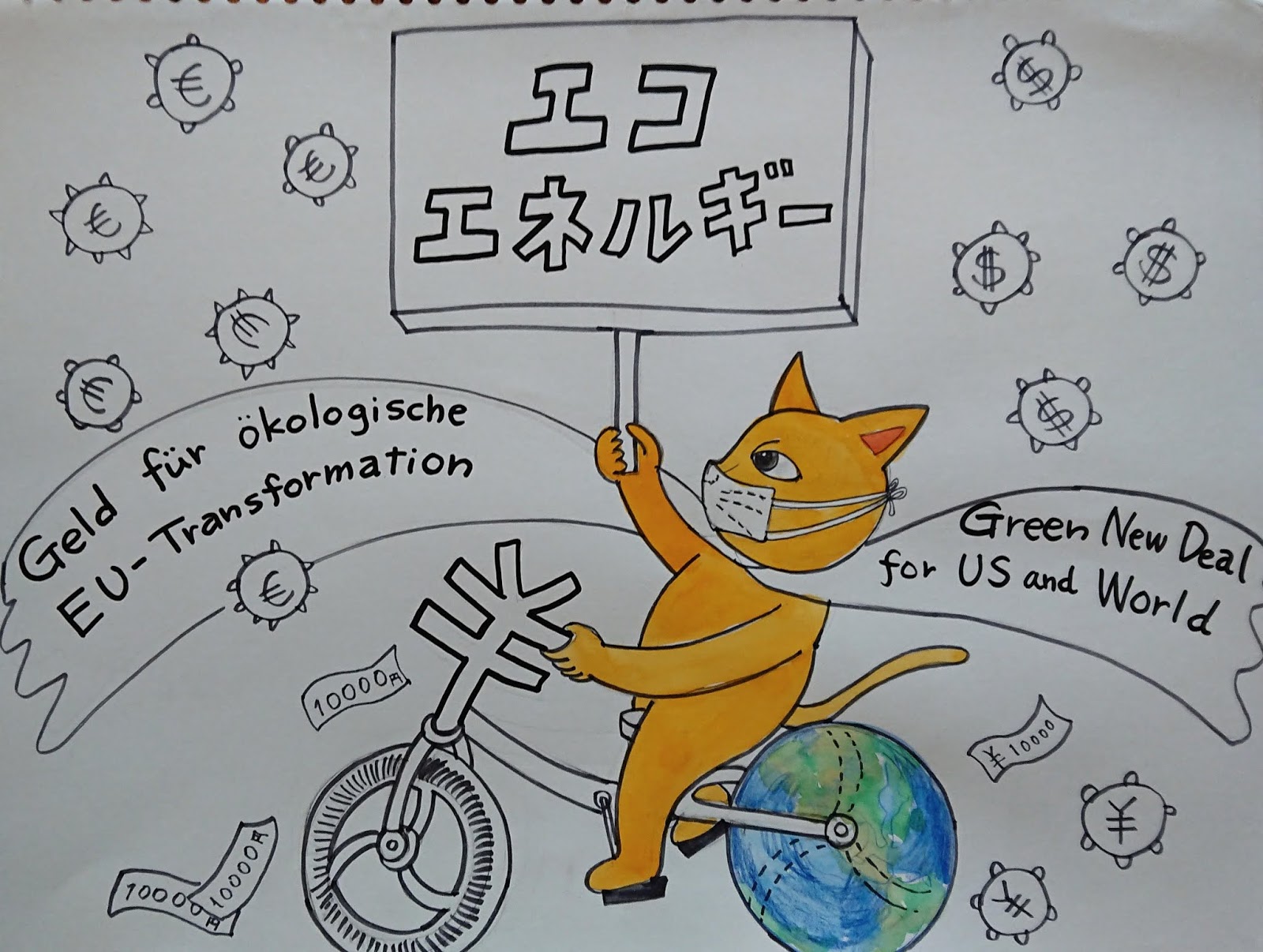
There is very famous scene in Film Spirited away (千と千尋の神隠し, Wp has more), where the main Chihiro looses her name and is from now on called Sen, which is one of the reason Chihiro is afterwards a slave of the witch Yubaba. Naming something and also re-naming is power. This applies to all languages, but especially English is very important, being the language of the American Empire (the OECD states) and the major language for Global exchange. The Global Fight for Climate Justice needs English as a tool for Global Exchange. But other countries with other National languages than English can and should contribute. I will argue here specially for German in Japan, which is still part of Job (teaching German as Foreign Language in a University in Japan, among other Subjects). The German "Energiewende" (energy transition, Wp has more) is far from perfect, but other countries (including Japan) can contribute from experiences in Germany. This Meme (Wp for more) used here is related to a character is used here in Nagoya, by the local electricity provider  (here is a Link, to Google the character can't desplayed here). Actually the Memes in this drawing (thank you Shinko)

are related to three political spheres, first to the EU, especially to Germany, where the population is still reluctant to create Corona-bonds (Politico has more, reading the article thoroughly shows, that Merkel is not for Corona bonds). The second political sphere is the US, with the notion of the new Green New Deal (Klein 2019). And the third space is of course Japan being able to create important Memes for the future of this planet. 

References
Klein, Naomi (2019), On Fire: The (Burning) Case for a Green New Deal